Gliffin Script Handwritten Font for Playful, Casual Branding
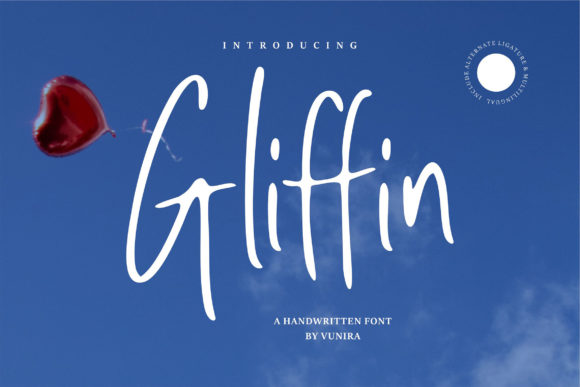
There’s that moment—right after you’ve poured your third small-batch candle, wiped soy wax off your counter, and opened Illustrator to design the label—when you realize the font you’ve been using just doesn’t *breathe* with your brand. It’s too stiff. Too generic. Too… not *you*. That’s when I typed “Gliffin” into my fonts folder—and instantly felt that little creative spark return. Gliffin is a fresh, unique script with a carefree attitude and a playful edge. Perfect for adding a quirky but casual feel, it comes with a large selection of natural-looking ligatures. This font is perfect for makers who want personality on every surface: labels, cards, packaging, and digital downloads.
Gliffin for Candle Labels and Handmade Product Packaging
I tested Gliffin first on 2” x 3” kraft sticker labels for lavender-vanilla candles. Its relaxed rhythm and soft entry/exit strokes made “Hand-Poured in Portland” look effortlessly warm—not forced, not fussy. Because Gliffin is a Script Handwritten font designed for display use, it shines at medium-to-large sizes (14–36 pt), especially on matte-finish stickers or recycled paper tags. The ligatures—like the graceful connection between “f” and “l” in “floral,” or the looping “th” in “earth”—add subtle movement without sacrificing readability. For Cricut and Silhouette users: Gliffin cuts cleanly at 18+ pt with standard blade settings, and its OpenType features activate easily in Design Space and Silhouette Studio when using the .OTF file.
Gliffin for Greeting Cards and Printable Stationery
When designing birthday cards for kids’ parties, I needed something joyful but not cartoonish—whimsical without being childish. Gliffin delivered. As a Fonts choice for printable stationery, it pairs beautifully with a light sans serif (think Montserrat Light or Poppins Thin) for body text. Use Gliffin for names (“Emma’s Big Day!”), short phrases (“Let’s Celebrate”), or decorative borders—never full paragraphs. Its natural flow mimics real pen-on-paper motion, so printed cards feel tactile and intentional. I printed a test run on 110 lb cardstock: no ink bleed, crisp curves, and zero ligature glitches—even with the alternate “a” and “g” glyphs enabled.
Gliffin for Wedding Invitations and Elegant Branding
Yes—Gliffin works for weddings. Not for formal black-tie envelopes, but for rustic-chic welcome signs, rehearsal dinner menus, or “Thank You” tags tucked into favor boxes. Its playful edge softens elegance; it says “we’re celebrating with joy, not perfection.” As a Script Handwritten font, Gliffin brings warmth to minimalist layouts—pair it with a refined serif like Cormorant Garamond for contrast, or let it stand alone over watercolor textures. I used it for a couple’s “Our Story” timeline poster: each date headline set in Gliffin, then supporting details in a clean sans. Customers noticed how “human” it felt—no robotic uniformity, just gentle variation, like handwriting you’d actually write.
Gliffin for Digital Printables and Planner Pages
For digital downloads—planner covers, habit trackers, or quote-based wall art—Gliffin adds instant charm without overwhelming layout. Because it’s a premium font built for display use, it scales well across screen sizes and PDF previews. I embedded Gliffin in a printable “Good Morning” planner page: the script header popped against a neutral background, while the rest stayed functional and legible. Pro tip: always export final printables as outlined text or PDF/X-1a if sharing commercially—this ensures Gliffin renders correctly for buyers, even if they don’t own the font. And yes—it’s licensed for commercial use, so you can sell templates, SVG bundles, or Canva-compatible designs without hesitation.
Gliffin for Tote Bags, Mugs, and Fabric-Based Merchandise
Testing Gliffin on a mockup of an organic cotton tote (“Make It Messy”) confirmed what I suspected: its casual confidence translates beautifully to fabric and ceramic surfaces. As a Fonts option for heat-transfer vinyl or sublimation, Gliffin holds up at 48–72 pt with bold weight (if included) or layered outlines for extra pop. Its high x-height and open counters prevent fill-in during printing—critical for mugs where curves get stretched across curvature. I paired it with a sturdy geometric sans (like Bebas Neue) for secondary text—keeping Gliffin as the emotional anchor, not the workhorse.
Gliffin for Seasonal Tags, Holiday Stickers, and Farmhouse Signs
Last December, I designed a set of mini holiday gift tags—“Peppermint Joy,” “Cocoa & Cozy,” “Snow Day Approved.” Gliffin’s playful edge gave them personality without leaning into cliché. Its natural ligatures made “Cozy” feel like a sigh, “Joy” like a laugh. As a Script Handwritten font, it’s ideal for seasonal craft designs where authenticity matters more than polish. On wood signs or chalkboard-style prints, Gliffin looks hand-lettered—not digitized. Bonus: the .OTF includes stylistic alternates and swashes, so you can rotate versions across a sticker sheet for visual variety without switching fonts.
What to Check Before Using Gliffin Commercially
- Licensing: Confirm your license covers physical products, digital templates, and resale—most Gliffin licenses do, but always verify.
- File Formats: Look for .OTF (OpenType) for full ligature and alternate support; avoid .TTF-only versions if you need advanced typography.
- Language Support: Gliffin includes extended Latin characters—great for English, Spanish, French, and German shop names—but double-check diacritics if targeting broader markets.
- Cutting & Printing: Test at your intended size first. Gliffin performs best above 14 pt for labels, 24 pt for signage, and 36 pt for apparel.